Story
Why Is Mercedes Called Mercedes?
The story behind the Mercedes name begins with Mercédès Jellinek, the daughter of Emil Jellinek, whose involvement with Daimler automobiles helped turn her first name into one of the most recognized names in automotive history. From the introduction of the Mercedes 35 PS in 1900 and its early racing success to the formation of Mercedes-Benz in 1926, this is the story of how a personal name became a lasting part of automotive history.
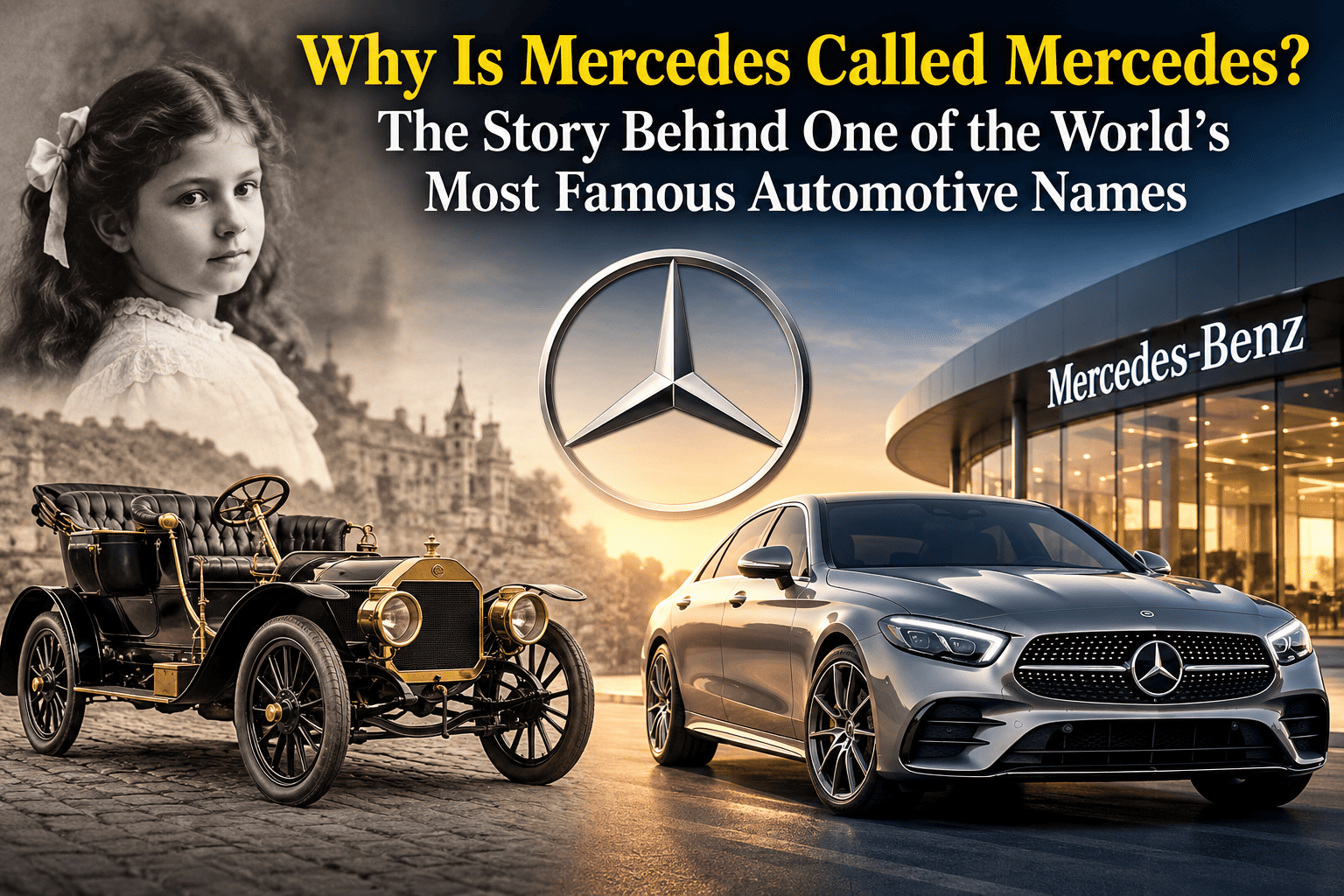
𝗪𝗵𝘆 𝗜𝘀 𝗠𝗲𝗿𝗰𝗲𝗱𝗲𝘀 𝗖𝗮𝗹𝗹𝗲𝗱 𝗠𝗲𝗿𝗰𝗲𝗱𝗲𝘀? 𝗧𝗵𝗲 𝗦𝘁𝗼𝗿𝘆 𝗕𝗲𝗵𝗶𝗻𝗱 𝗢𝗻𝗲 𝗼𝗳 𝘁𝗵𝗲 𝗪𝗼𝗿𝗹𝗱'𝘀 𝗠𝗼𝘀𝘁 𝗙𝗮𝗺𝗼𝘂𝘀 𝗔𝘂𝘁𝗼𝗺𝗼𝘁𝗶𝘃𝗲 𝗡𝗮𝗺𝗲𝘀
The story of the Mercedes name begins with a person, not a car.
Today, Mercedes-Benz is one of the most recognizable names in the automotive world. The name is associated with automobiles, engineering, luxury, performance and a history that stretches back to the earliest years of the modern automobile. But the word Mercedes was not originally created as the name of a company or a car. Its story began with a young girl named Mercédès Jellinek and her father, Emil Jellinek, a businessman and automobile enthusiast who became closely involved with Daimler automobiles at the beginning of the 20th century.
At that time, the automobile industry was still in its formative years. Motor vehicles were evolving rapidly, manufacturers were experimenting with new engineering ideas, and motor racing was becoming an important way to demonstrate the performance of automobiles. Emil Jellinek understood the growing importance of both engineering and public recognition. He became an important customer and promoter of Daimler-Motoren-Gesellschaft, or DMG, and encouraged the company to develop automobiles with greater performance and more advanced designs.
𝗧𝗵𝗲 𝗻𝗮𝗺𝗲 𝗠𝗲𝗿𝗰𝗲𝗱𝗲𝘀 𝗲𝗻𝘁𝗲𝗿𝗲𝗱 𝘁𝗵𝗲 𝗮𝘂𝘁𝗼𝗺𝗼𝗯𝗶𝗹𝗲 𝘄𝗼𝗿𝗹𝗱 𝘁𝗵𝗿𝗼𝘂𝗴𝗵 𝗘𝗺𝗶𝗹 𝗝𝗲𝗹𝗹𝗶𝗻𝗲𝗸 𝗮𝗻𝗱 𝗵𝗶𝘀 𝗱𝗮𝘂𝗴𝗵𝘁𝗲𝗿, 𝗠𝗲𝗿𝗰𝗲𝗱𝗲𝘀.
Jellinek began participating in automobile races on the French Riviera in the late 1890s. From 1899 onward, he entered Daimler cars in competitions under the pseudonym "Monsieur Mercedes." The name came from the first name of his daughter, Mercédès, who was born in Vienna in 1889.
At first, Mercedes was simply a personal name used by Jellinek in connection with his automobile activities. It was not yet the name of an automobile company or a global brand. However, Jellinek's close relationship with Daimler and his influence on the development and promotion of its automobiles gradually gave the name a much greater significance.
The important change came in 1900, when Jellinek and Daimler-Motoren-Gesellschaft agreed on the development of a new automobile and engine. The new engine was to carry the name Daimler-Mercedes, turning the name that Jellinek had previously used as a pseudonym into a product name.
𝗧𝗵𝗲 𝗠𝗲𝗿𝗰𝗲𝗱𝗲𝘀 𝟯𝟱 𝗣𝗦 𝗯𝗲𝗰𝗮𝗺𝗲 𝘁𝗵𝗲 𝗮𝘂𝘁𝗼𝗺𝗼𝗯𝗶𝗹𝗲 𝘁𝗵𝗮𝘁 𝗴𝗮𝘃𝗲 𝘁𝗵𝗲 𝗻𝗮𝗺𝗲 𝗶𝘁𝘀 𝗳𝗶𝗿𝘀𝘁 𝗺𝗮𝗷𝗼𝗿 𝗶𝗱𝗲𝗻𝘁𝗶𝘁𝘆.
On 22 December 1900, Daimler delivered the first car equipped with the new 35 PS engine to Jellinek in Nice. The automobile became known as the Mercedes 35 PS.
The car was significant not simply because it carried a new name, but because its engineering represented a major change in automobile design. It was developed under the direction of Wilhelm Maybach, Daimler's chief engineer, and was designed around the requirements of a motor vehicle rather than simply adapting the basic form of a horse-drawn carriage.
The Mercedes 35 PS featured a powerful four-cylinder engine, a relatively long wheelbase, a wide track and a low centre of gravity. It also used a honeycomb radiator developed by Maybach. These characteristics contributed to the vehicle's performance, stability and distinctive appearance.
The result was an automobile that looked and behaved differently from many of its predecessors.
It was an important moment in the development of the modern automobile.
The name Mercedes became widely recognized through the car's success in motor racing.
The Mercedes 35 PS made its major public impression during Nice Week in March 1901. Mercedes automobiles achieved a series of important victories in the events, demonstrating the performance of the new design.
At the beginning of the 20th century, motor racing was closely connected with automobile development. Racing provided manufacturers with an opportunity to test their vehicles under demanding conditions and demonstrate their engineering capabilities to potential customers.
The success of the Mercedes cars therefore had significance beyond the race results themselves. It gave the Mercedes name considerable public attention and helped establish it as a recognizable name in the automobile market.
The connection between the name and the automobile became increasingly strong.
What had begun as the first name of Jellinek's daughter was now attached to a vehicle that was attracting attention for its engineering and performance.
The success of the Mercedes automobiles turned the name into a valuable commercial identity.
Following the racing and market success of the Mercedes cars, Daimler-Motoren-Gesellschaft formally sought legal protection for the name. On 23 June 1902, the company applied to register "Mercédès" as a trademark, and the name received legal protection on 26 September 1902.
This was an important step in the history of the brand. Mercedes was no longer simply a name used by Emil Jellinek. It had become an official trademark associated with Daimler automobiles.
The development also explains why the name became so closely connected with Daimler passenger cars. The company was not simply choosing a fashionable name for its products. The name already had recognition among customers and automobile enthusiasts because of Jellinek's activities and the success of the vehicles carrying it.
Behind the famous name was a young woman who had no role in designing the automobile that carried it.
Mercédès Jellinek herself was not an engineer, automobile designer or company founder. Her importance to this story comes from her connection to Emil Jellinek, who chose her first name for his automobile activities.
Her name, however, became remarkably successful as a brand.
In June 1903, Emil Jellinek received permission to change his surname to Jellinek-Mercedes. By then, the name had become so strongly associated with his automobile activities that it had also become part of his own identity.
This remains one of the more unusual stories in automotive history. A father's decision to use his daughter's first name eventually created the foundation for a name that would become known around the world.
The Mercedes name and the three-pointed star have separate histories.
Another common misunderstanding concerns the famous three-pointed star. The star was not the source of the Mercedes name, and the two did not originate as one combined symbol.
The three-pointed star developed separately within the history of Daimler. In 1900, Gottlieb Daimler's sons, Paul and Adolf Daimler, adapted a three-pointed star for use as a brand symbol. Daimler later registered the star as a trademark.
Over time, the Mercedes name and the three-pointed star became closely associated with one another. Eventually, they formed one of the most recognizable identities in the automotive industry.
This distinction is important because the modern Mercedes-Benz logo can make the two elements appear to have been created together. Historically, however, the Mercedes name and the star developed through separate stages.
The next major chapter came in 1926, when Daimler and Benz became one company.
For more than two decades, Mercedes had been used as the brand name for Daimler passenger cars. But the name Mercedes-Benz emerged after the merger of two major German automobile manufacturers.
In 1926, Daimler-Motoren-Gesellschaft and Benz & Cie. merged, forming Daimler-Benz AG. From that point, the company's automobiles carried the name Mercedes-Benz.
The two parts of the name represented two different histories.
"Mercedes" came from the name associated with Mercédès Jellinek and the Daimler automobiles promoted by her father.
"Benz" came from Carl Benz, one of the pioneers of the automobile and the founder associated with Benz & Cie.
The merger brought these two histories together under a single automotive identity.
Mercedes-Benz was therefore not the original name of the company. It was the result of a long historical development that began with Daimler automobiles, the personal name of Mercédès Jellinek, and the eventual merger between Daimler and Benz.
What makes the Mercedes story remarkable is how far the name travelled from its original meaning.
For Emil Jellinek, Mercedes was his daughter's first name.
For the racing world of the late 1890s and early 1900s, it became the name used by Jellinek in competition.
For Daimler, it became the name of a new generation of automobiles.
After the success of the Mercedes 35 PS, it became a registered trademark.
And after the 1926 merger, it became part of the name Mercedes-Benz.
The meaning of the name therefore changed gradually, with each stage adding another layer to its history.
The Mercedes name was not created through a complicated corporate formula. It came from a simple family connection that happened at a significant moment in automotive history.
Emil Jellinek used his daughter's name.
Daimler adopted the name for a new automobile.
The Mercedes 35 PS demonstrated the potential of the new design.
Racing success brought the name greater attention.
Daimler officially registered the name as a trademark.
And the later merger with Benz created Mercedes-Benz.
Each event played a part in transforming a personal name into an internationally recognized automotive identity.
More than a century later, the personal story behind the name is easy to overlook.
When people see the word Mercedes today, they naturally think of automobiles and the three-pointed star. The connection with Mercédès Jellinek is less familiar, even though it is at the heart of the brand's early history.
The story is especially interesting because Mercédès Jellinek did not set out to create an automotive legacy. She simply carried a first name that her father chose to use in connection with his automobile activities.
Yet that name became attached to one of the most significant automobiles of the early motor age.
The Mercedes 35 PS helped demonstrate a new direction in automobile design. Its success in competition helped bring attention to the name. The trademark gave the name a formal commercial identity. And the 1926 merger with Benz carried it into a new chapter as Mercedes-Benz.
The history of Mercedes is ultimately the story of how a personal name became part of the history of the automobile.
It began with Mercédès Jellinek, a young girl born in Vienna in 1889.
Her father, Emil Jellinek, used her first name while promoting and racing Daimler automobiles.
In 1900, the name became associated with a new Daimler automobile and its 35 PS engine.
In 1901, the Mercedes 35 PS gained attention through its successful performances during Nice Week.
In 1902, the Mercedes name received legal trademark protection.
In 1903, Emil Jellinek himself adopted the surname Jellinek-Mercedes.
And in 1926, the merger of Daimler-Motoren-Gesellschaft and Benz & Cie. created the Mercedes-Benz name.
A daughter's name became the name of an automobile, the name became a trademark, and the trademark eventually became part of one of the most recognizable automotive brands in the world.
𝗧𝗵𝗮𝘁 𝗶𝘀 𝘄𝗵𝘆 𝗠𝗲𝗿𝗰𝗲𝗱𝗲𝘀 𝗶𝘀 𝗰𝗮𝗹𝗹𝗲𝗱 𝗠𝗲𝗿𝗰𝗲𝗱𝗲𝘀.
It is not an abbreviation, a technical term or a name invented solely for a marketing campaign. Its origin is much more personal. It comes from the first name of Mercédès Jellinek, whose name became connected with Daimler automobiles at a defining moment in the development of the modern motor car.
More than 120 years later, the name remains part of automotive history.
What began as a father's choice of his daughter's name became Mercedes, and eventually Mercedes-Benz.
IonVolt Research Team
IonVolt Research Team